There's still a lot of misunderstanding out there about where the Halo Wars engine technology came from. Starting in very early 2005 the HW team wrote a new engine pretty much from scratch. The Age3 code was only single threaded, didn't use SIMD, and consumed huge amounts of RAM. (Age3 used over 32MB just for UTF16 strings - not good for a console game!) The "Bang!" engine ran at ~7Hz and took around three to five minutes to load on the early Xbox 360 devkits.
Colt McAnlis (now Google), Billy Khan (now at Id Software) and I wrote the entire Xbox 360-only renderer almost from scratch. We started out with Age3's particle renderer and my "wrench" demo deferred shading engine for SM 2.0 hardware. Ensemble Studios basically gave us a blank check to do whatever we wanted on Xbox 360. (What good times!)
Age3's particle engine (written partially or mostly by Graham Devine, now at Magic Leap) was so good that the artists refused to allow us to rewrite it. Billy and I threaded it by converting it into jobs, and we SIMD'ified all the key loops using Altivec ops. We also offloaded as many computations as we could into vertex/pixel shaders, to cut down on the very high CPU cost of the original code.
The Halo Wars particle engine would have ran circles around Age3's (once ported back to x86).
Please don't get me wrong, Age3 was a beautiful and fun game, and I loved working on it. The team was super easy and pleasant to work with. Just remember that Halo Wars was created by a very different team with different goals. We had some pretty awesome goals for the next Halo Wars, but the studio was shut down.
Showing posts sorted by relevance for query halo wars. Sort by date Show all posts
Showing posts sorted by relevance for query halo wars. Sort by date Show all posts
Monday, November 28, 2016

Sunday, November 29, 2015
Important aspects of LZHAM's design
I'm going to go through many of the major lossless codecs (LZMA, Zstd, LZ4, Deflate, bzip2, PAQ, etc.) and list the features and properties that made them unique or interesting, especially when first released. Let's start with LZHAM (yes I'm shamelessly beating my own drum here, but hey it's my tech blog). I think it's very important and interesting to understand the past.
LZHAM alpha was first released in Aug. 15, 2010 (according to Google Code), but the fast entropy decoder experiments and classes were written in early 2009 (before I joined Valve). At the time, the practical lossless data compression community didn't seem to have much focus or direction. They were kinda all over the map, and Charle Bloom's excellent reverse engineering of LZMA did not occur until after LZHAM's public release.
This codec was designed for next-generation video games, basically titles I thought would be eventually made with Source 2. Valve was awesome at allowing developers to work on open source and even commercial projects at home. The team didn't think data compression was an important thing to work on, so I decided to work on it on my spare time.
For some background, I was not able to use LZMA on Halo Wars because it was incredibly slow on X360, and Microsoft Game Studios stopped using my internal highly X360 optimized Deflate codec ("eslib") and switched to LZX. I used 7-zip on the Halo Wars build server, and was very impressed with its ratio, especially when in Deflate mode. I always wondered how it was able to achieve such high ratios when compressing to the old Deflate format, and I wanted to understand why.
Some of the major features it demonstrated:
- Micro-threaded compressor
Dictionary updating, match finding, and parsing all in parallel.
A lock-free approach is used to communicate between parser threads and match finder threads.
The usual approach to threading a compressor blocks up the input and sacrifices ratio, which is not necessary with the correct design.
Inspired by my experience writing the multithreaded Halo Wars engine, and the lock free stuff was inspired by experiments I was seeing done on Source 2's graphics engine.
- Interleaved coding
Huffman and binary arithmetic coding interleaved into the same bitstream. The compressor batches all symbols and simulates the entropy decoding steps the decompressor will use in order to figure out how to interleave the output bitstream.
I came up with this design because I wanted a simple symbol_codec class that supported totally free form usage of arithmetic, Huffman, and raw bits. This class was inspired by Amir Said's excellent papers and sample code. I tested it on a laptop and just keep on optimizing it for higher decoding performance over a few weeks time.
LZHAM also showed that Huffman coding still had legs in high ratio codecs. Very low or high probability symbols (what I called high "skew" symbols), where Huffman's prefix coding limitations are most obvious, can use fast and simple binary arithmetic coding, while everything else can be done with static Huffman coding, with bulk table updating for adaption. Also around this time, Andrew Polar showed it was possible to quickly update prefix codes.
- Best of X arrivals parsing (called "extreme" parsing in the code)
This was obvious after figuring out how to construct a parse graph.
Inspired by the path finding algorithms used in games.
LZHAM alpha was first released in Aug. 15, 2010 (according to Google Code), but the fast entropy decoder experiments and classes were written in early 2009 (before I joined Valve). At the time, the practical lossless data compression community didn't seem to have much focus or direction. They were kinda all over the map, and Charle Bloom's excellent reverse engineering of LZMA did not occur until after LZHAM's public release.
This codec was designed for next-generation video games, basically titles I thought would be eventually made with Source 2. Valve was awesome at allowing developers to work on open source and even commercial projects at home. The team didn't think data compression was an important thing to work on, so I decided to work on it on my spare time.
For some background, I was not able to use LZMA on Halo Wars because it was incredibly slow on X360, and Microsoft Game Studios stopped using my internal highly X360 optimized Deflate codec ("eslib") and switched to LZX. I used 7-zip on the Halo Wars build server, and was very impressed with its ratio, especially when in Deflate mode. I always wondered how it was able to achieve such high ratios when compressing to the old Deflate format, and I wanted to understand why.
Some of the major features it demonstrated:
- Micro-threaded compressor
Dictionary updating, match finding, and parsing all in parallel.
A lock-free approach is used to communicate between parser threads and match finder threads.
The usual approach to threading a compressor blocks up the input and sacrifices ratio, which is not necessary with the correct design.
Inspired by my experience writing the multithreaded Halo Wars engine, and the lock free stuff was inspired by experiments I was seeing done on Source 2's graphics engine.
- Interleaved coding
Huffman and binary arithmetic coding interleaved into the same bitstream. The compressor batches all symbols and simulates the entropy decoding steps the decompressor will use in order to figure out how to interleave the output bitstream.
I came up with this design because I wanted a simple symbol_codec class that supported totally free form usage of arithmetic, Huffman, and raw bits. This class was inspired by Amir Said's excellent papers and sample code. I tested it on a laptop and just keep on optimizing it for higher decoding performance over a few weeks time.
LZHAM also showed that Huffman coding still had legs in high ratio codecs. Very low or high probability symbols (what I called high "skew" symbols), where Huffman's prefix coding limitations are most obvious, can use fast and simple binary arithmetic coding, while everything else can be done with static Huffman coding, with bulk table updating for adaption. Also around this time, Andrew Polar showed it was possible to quickly update prefix codes.
- Best of X arrivals parsing (called "extreme" parsing in the code)
This was obvious after figuring out how to construct a parse graph.
Inspired by the path finding algorithms used in games.
- Other things it did that I think are important:
zlib compatible API - It's the standard "universal" lossless compression API, it makes no sense not to support it. To my knowledge LZHAM and miniz were the first to try and copy zlib's API.
Streaming support - I question how useful this is to many developers, but you need it otherwise you're limited to available RAM or have to use blocking which hurts ratio.
Seed dictionaries - Occasionally valuable.
Every update was thoroughly tested before pushing the code. Random failures or crashes = the kiss of death for a new codec trying to be accepted.
For LZHAM I decided that the best way to get noticed as adding value in a very competitive space was to match LZMA's ratio as closely as possible and just move "right" (faster) on the decompression speed/ratio Pareto frontier. I purposely de-emphasized the compression speed/ratio frontier, favoring offline compression.
One critical mistake I made in the alphas was optimizing too much for the Large Text Compression Benchmark, which is 100MB of Wikipedia text. This led to me going down a blind alley with higher order coding experiments, which used way too many Huffman tables.
zlib compatible API - It's the standard "universal" lossless compression API, it makes no sense not to support it. To my knowledge LZHAM and miniz were the first to try and copy zlib's API.
Streaming support - I question how useful this is to many developers, but you need it otherwise you're limited to available RAM or have to use blocking which hurts ratio.
Seed dictionaries - Occasionally valuable.
Every update was thoroughly tested before pushing the code. Random failures or crashes = the kiss of death for a new codec trying to be accepted.
For LZHAM I decided that the best way to get noticed as adding value in a very competitive space was to match LZMA's ratio as closely as possible and just move "right" (faster) on the decompression speed/ratio Pareto frontier. I purposely de-emphasized the compression speed/ratio frontier, favoring offline compression.
One critical mistake I made in the alphas was optimizing too much for the Large Text Compression Benchmark, which is 100MB of Wikipedia text. This led to me going down a blind alley with higher order coding experiments, which used way too many Huffman tables.
Friday, December 11, 2015
Why by-convention read-only shared state is bad
I'm going to switch topics from my usual stuff to something else I find interesting: multithreading.
Back at Ensemble Studios, I remember working on the multithreaded rendering code in both Age of Empires 3 and Halo Wars. At the time (2003-2004 timeframe), multithreading was a new thing for game engines. Concepts like shared state, producer consumer queues, TLS, semaphores/events, condition variables, job systems, etc. were new things to many game engineers. (And lockfree approaches were considered very advanced, like Area 51 grade stuff.) Age of Empires 3 was a single threaded engine, but we did figure out how to use threading for at least two things I'm aware of: the loading screen, and jobified skinning.
On Age3, it was easy to thread the SIMD skinning code used to render all skinned meshes, because I analyzed the rendering code and determined that the input data we needed for "jobified" skinning was guaranteed to be stable during the execution of the skinning job. (The team also said it seemed "impossible" to do this, which of course just made me more determined to get this feature working and shipped.)
The key thing about making it work was this: I sat down and said to the other rendering programmer who owned this code, "do not change this mesh and bone data in between this spot and this spot in your code -- or the multithreaded skinning code will randomly explode!". We then filled in the newly introduced main thread bubble with some totally unrelated work that couldn't possibly modify our mesh/bone data (or so we thought!), and in our little world all was good.
This approach worked, but it was dangerous and fragile because it introduced a new constraint into the codebase that was hard to understand or even notice by just locally studying the code. If someone would have changed how the mesh renderer worked, or changed the data that our skinning jobs accessed, they could have introduced a whole new class of bugs (such as Heisenbugs) into the system without knowing it. Especially in a large rapidly changing codebase, this approach is a slippery slope.
We were willing to do it this way in the Age3 codebase because very few people (say 2-3 at most in the entire company) would ever touch this very deep rendering code. I made sure the other programmer who owned the system had a mental model of the new constraint, also made sure there were some comments and little checks in there, and all was good.
Importantly, Ensemble had extremely low employee turnover, and this low-level engine code rarely changed. Just in case the code exploded in a way I couldn't predict on a customer's machine, I put in a little undocumented command line option that disabled it completely.
Age3 and Halo Wars made a lot of use of the fork and join model for multithreading. Halo Wars used the fork and join model with a global system, and we allowed multiple threads (particularly the main and render threads) to fork and join independently.
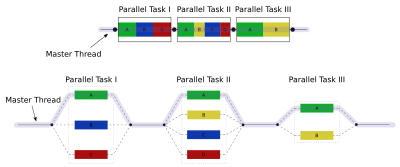
See those sections where you have multiple tasks stacked up in parallel? Those parts of the computation are going to read some data, and if it's some global state it means you have a potential conflict with the main thread. Anything executed in those parallel sections of the overall computation must follow your newly introduced conventions on which shared state data must remain stable (and when), or disaster ensues.
Looking back now, I realize this approach of allowing global access to shared state that is supposed to be read-only and stable by convention or assumption is not a sustainable practice. Eventually, somebody somewhere is going to introduce a change using only their "local" mental model of the code that doesn’t factor in our previously agreed upon data stability constraint, and they will break the system in a way they don't understand. Bugs will come in, the engine will crash in some way randomly, etc. Imagine the damage to a codebase if this approach was followed by dozens of systems, instead of just one.
Creating and modifying large scale software is all about complexity management. Our little Age3 threaded skinning change made the engine more complex in ways that were hard to understand, talk about, or reason about. When you are making decisions about how to throw some work onto a helper thread, you need to think about the overall complexity and sustainability of your approaches at a very high level, or your codebase is eventually going to become buggy and practically unchangeable.
One sustainable engineering solution to this problem is Read Copy Update (RCU, used in the Linux kernel). With RCU, there are simple clear policies to understand, like "you must bump up/down the reference to any RCU object you want to read”, etc. RCU does introduce more complexity, but now it’s a first class engine concept that other programmers can understand and reason about.
RCU is a good approach for sharing large amounts of data, or large objects. But for little bits of shared state, like a single int or whatever, the overhead is pretty high.
Multithreading Skinning on Age of Empires 3
Back at Ensemble Studios, I remember working on the multithreaded rendering code in both Age of Empires 3 and Halo Wars. At the time (2003-2004 timeframe), multithreading was a new thing for game engines. Concepts like shared state, producer consumer queues, TLS, semaphores/events, condition variables, job systems, etc. were new things to many game engineers. (And lockfree approaches were considered very advanced, like Area 51 grade stuff.) Age of Empires 3 was a single threaded engine, but we did figure out how to use threading for at least two things I'm aware of: the loading screen, and jobified skinning.
On Age3, it was easy to thread the SIMD skinning code used to render all skinned meshes, because I analyzed the rendering code and determined that the input data we needed for "jobified" skinning was guaranteed to be stable during the execution of the skinning job. (The team also said it seemed "impossible" to do this, which of course just made me more determined to get this feature working and shipped.)
The key thing about making it work was this: I sat down and said to the other rendering programmer who owned this code, "do not change this mesh and bone data in between this spot and this spot in your code -- or the multithreaded skinning code will randomly explode!". We then filled in the newly introduced main thread bubble with some totally unrelated work that couldn't possibly modify our mesh/bone data (or so we thought!), and in our little world all was good.
This approach worked, but it was dangerous and fragile because it introduced a new constraint into the codebase that was hard to understand or even notice by just locally studying the code. If someone would have changed how the mesh renderer worked, or changed the data that our skinning jobs accessed, they could have introduced a whole new class of bugs (such as Heisenbugs) into the system without knowing it. Especially in a large rapidly changing codebase, this approach is a slippery slope.
We were willing to do it this way in the Age3 codebase because very few people (say 2-3 at most in the entire company) would ever touch this very deep rendering code. I made sure the other programmer who owned the system had a mental model of the new constraint, also made sure there were some comments and little checks in there, and all was good.
Importantly, Ensemble had extremely low employee turnover, and this low-level engine code rarely changed. Just in case the code exploded in a way I couldn't predict on a customer's machine, I put in a little undocumented command line option that disabled it completely.
Age3 and Halo Wars made a lot of use of the fork and join model for multithreading. Halo Wars used the fork and join model with a global system, and we allowed multiple threads (particularly the main and render threads) to fork and join independently.
See those sections where you have multiple tasks stacked up in parallel? Those parts of the computation are going to read some data, and if it's some global state it means you have a potential conflict with the main thread. Anything executed in those parallel sections of the overall computation must follow your newly introduced conventions on which shared state data must remain stable (and when), or disaster ensues.
Complexity Management
Looking back now, I realize this approach of allowing global access to shared state that is supposed to be read-only and stable by convention or assumption is not a sustainable practice. Eventually, somebody somewhere is going to introduce a change using only their "local" mental model of the code that doesn’t factor in our previously agreed upon data stability constraint, and they will break the system in a way they don't understand. Bugs will come in, the engine will crash in some way randomly, etc. Imagine the damage to a codebase if this approach was followed by dozens of systems, instead of just one.
Creating and modifying large scale software is all about complexity management. Our little Age3 threaded skinning change made the engine more complex in ways that were hard to understand, talk about, or reason about. When you are making decisions about how to throw some work onto a helper thread, you need to think about the overall complexity and sustainability of your approaches at a very high level, or your codebase is eventually going to become buggy and practically unchangeable.
One solution: RCU
One sustainable engineering solution to this problem is Read Copy Update (RCU, used in the Linux kernel). With RCU, there are simple clear policies to understand, like "you must bump up/down the reference to any RCU object you want to read”, etc. RCU does introduce more complexity, but now it’s a first class engine concept that other programmers can understand and reason about.
RCU is a good approach for sharing large amounts of data, or large objects. But for little bits of shared state, like a single int or whatever, the overhead is pretty high.
Another solution: Deep Copy
The other sustainable approach is to deep copy the global data into a temporary job-specific context structure, so the job won't access the data as shared/global state. The deep copy approach is even simpler, because the job just has its own little stable snapshot of the data which is guaranteed to stay stable during job execution.
Unfortunately, implementing the deep copy approach can be taxing. What if a low-level helper system used by job code (that previously accessed some global state) doesn’t easily have access to your job context object? You need a way to somehow get this data “down” into deeper systems.
The two approaches I’m aware of are TLS, or (for lack of a better phrase) “value plumbing”. TLS may be too slow, and is crossing into platform specific land. The other option, value plumbing, means you just pass the value (or a pointer to your job context object) down into any lower level systems that need it. This may involve passing the context pointer or value data down several layers through your callstacks.
But, you say, this plumbing approach is ugly because of all these newly introduced method variables! But, it is a sustainable approach in the long term, like RCU. Eventually, you can refactor and clean up the plumbing code to make it cleaner if needed, assuming it’s a problem at all. You have traded off some code ugliness for a solution that is reliable in the long term.
Sometimes, when doing large scale software engineering, you must make changes to codebases that may seem ugly (like value plumbing) as a tradeoff for higher sustainability and reliability. It can be difficult to make these choices, so some higher level thinking is needed to balance the long term pros and cons of all approaches.
But, you say, this plumbing approach is ugly because of all these newly introduced method variables! But, it is a sustainable approach in the long term, like RCU. Eventually, you can refactor and clean up the plumbing code to make it cleaner if needed, assuming it’s a problem at all. You have traded off some code ugliness for a solution that is reliable in the long term.
Conclusion
Sometimes, when doing large scale software engineering, you must make changes to codebases that may seem ugly (like value plumbing) as a tradeoff for higher sustainability and reliability. It can be difficult to make these choices, so some higher level thinking is needed to balance the long term pros and cons of all approaches.
Thursday, December 17, 2015
Light Indexed Deferred Rendering
I can't find this information anywhere on the net, so I'll put it here. I've always been fascinated by the various alternatives to pure deferred shading, so I was really excited when I first encountered a light indexed variant.
Backstory: Halo Wars
I tired of the challenges inherent in pure deferred rendering approaches by around 2005, so I purposely used several deferred rendering alternatives on Halo Wars. HW combined X360 specific multi-light forward lighting for precise lighting (or for lights that required dynamic shadowing and/or cookies), along with an approximate voxel-based method for much cheaper, lower priority "bulk" lights.
In the voxel based approximate approach, one volume texture contained the total incoming light at each voxel's center (irradiance), and the other contained the weighted average of all the light vectors from all the lights that influenced each voxel (with the total weight in alpha). From this data, it was possible to compute approximate exit radiances at any point/normal. This "voxel light buffering" system was very efficient and scalable, so it was also used to illuminate terrain chunks and meshes by most omni/spot lights in the game. As an added bonus, it was easy and cheap to illuminate particles using this approach too.
We couldn't use multi-light forward on everything because the GPU fillrate cost from each added light was too high, and our object vs. light overlap check (just simple bounding box vs. sphere or cone) was very rough. Especially on terrain chunks, the extra pixel cost was brutal.
I had the GPU update the voxel textures each frame. Lights became as cheap as super low-res sprites, so we could have hundreds of them. The voxel texture's bounds in worldspace always covered the terrain in the view frustum (up to a certain depth and world height). The resolution was either 64x64x16 or 128x128x16 (from memory).
I found this approach interesting because it could achieve both diffuse and specular lighting, and because it visually degraded well when more than one light hit a voxel. Anyhow, after Ensemble collapsed I put all this stuff into the back of my mind.
I found this approach interesting because it could achieve both diffuse and specular lighting, and because it visually degraded well when more than one light hit a voxel. Anyhow, after Ensemble collapsed I put all this stuff into the back of my mind.
Source 2
When I first came to Valve after HW shipped (late 2009), I kept encouraging the graphics programmers to look for another viable alternative to deferred rendering. One day, in early to middle 2010, I came in to work and Shanon Drone showed me his amazing prototype implementation of a voxel based forward rendering variant of what is known as Light Indexed Deferred Lighting. (So what would the name be? Voxed Based Light Indexed Forward Lighting?)
From what I remember, his approach voxelized in projection space. Each voxel contained an integer index into a list of lights that overlapped with that voxel's worldspace bounding box. The light lists were stored in a separate texture. The CPU (using SIMD instructions) was used to update the voxel texture, and the CPU also filled in the lightlist texture.
The scene was rendered just like with forward lighting, except the pixel shader fetched from the voxel light index texture, and then iterated over all the lights using a dynamic loop. The light parameters were fetched from the lightlist texture. I don't remember where the # of lights per voxel was stored, it could have been in either texture.
From what I remember, his approach voxelized in projection space. Each voxel contained an integer index into a list of lights that overlapped with that voxel's worldspace bounding box. The light lists were stored in a separate texture. The CPU (using SIMD instructions) was used to update the voxel texture, and the CPU also filled in the lightlist texture.
The scene was rendered just like with forward lighting, except the pixel shader fetched from the voxel light index texture, and then iterated over all the lights using a dynamic loop. The light parameters were fetched from the lightlist texture. I don't remember where the # of lights per voxel was stored, it could have been in either texture.
The new approach was ported and tested on X360, and I remember we switched to packing the light indices (or something - it's been a long time!) into an array of constant registers to make the approach practical at all on X360.
I have no idea if this is published anywhere, but I remember the day very clearly as an internal breakthrough. It's been many years now, so I doubt anyone will mind me mentioning it.
Published material on light indexed deferred/forward rendering techniques (or similar variants):
I'll update this blog post as I run across links:
Technical Paper on Light Indexed Deferred Lighting - Dec. 2007
Research into light indexed deferred rendering (Google Code)
Research into light indexed deferred rendering (github)
Practical Clustered Shadowing - Avalanche’s solution in Just Cause 3
Tiled Forward Shading Links
Forward vs Deferred vs Forward+ Rendering with DirectX 11 - by Jeremiah van Oosten
Research into light indexed deferred rendering (github)
Practical Clustered Shadowing - Avalanche’s solution in Just Cause 3
Tiled Forward Shading Links
Forward vs Deferred vs Forward+ Rendering with DirectX 11 - by Jeremiah van Oosten
Misc:
Saturday, December 5, 2015
How to deeply integrate a data compressor into a game engine
Intro
We're still in a "path finding into the future" mode here at Unity. We are now thinking about breaking down the "Berlin Wall" between game engines like Unity and the backend data compressor. We have a lot of ideas, and some are obvious things I've already blogged about like CompressQuery(). These next ideas are deeper, and less concrete, but I think they are interesting.
Below is a technical note from our internal Compression Team Confluence page (internal first to get early feedback on the possibility of deep Unity engine integration). It describes a couple of interesting proposals triggered by several great discussions with Alexander Suvorov, also on the Compression Team. There are no guarantees this stuff will work out, but we need to think and talk about it because it could lead to even better ideas.
Some ideas on how to deeply integrate a data compressor into a game engine
The key question on the Compression Team that we should be answering is: How do we build a data compression engine that Unity can talk to better, so we get higher ratios?
Right now everybody else spends endless dev time on optimizing the backend compressor itself (entropy coders, LZ virtual machine/instruction set changes etc.), which is a great thing to do but there are other ways of improving ratio too. This is done because the folks writing compressors usually don't control the caller. But this is not true for us, because Alexander and I can change anything in the entire Unity stack (we can change the caller and we can change the data compressor).
The golden rule in mainstream lossless compression has been: "you cannot change the submission API", for compatibility/simplicity reasons. Basically, "API and Data Format Compatibility=God" for a codec. The coding literature I've seen doesn't go much (if at all) into the API side either, because the agreed assumption is that the caller doesn't typically know much or care about the details inside lossless data compression libraries. It's just a blob of bytes, here you go.
Since artificial "rules are meant to be broken" (Joachim's observation), there seems to be at least two interesting approaches to breaking down the barrier, that can also be mixed together. Both involve a superset compressor/decompressor API:
1. Direct Context Control (DCC)
Let's try allowing the caller to have some control over the compressor's internal coding contexts (or select between statistical models).
In this API, the caller specifies the upcoming index of the current context to use while streaming data to/from the codec. The context can be as simple as a programmer chosen ID, or a structure member ID - anything the caller wants as long as it's consistent (and as long as they also specify same context ID during decompression) They can say stuff like "context0=DWORD's" and "context1=floats", or they can describe individual bytes within these elements, etc.
We don't care what the context really means, all we care about is that the caller doesn't lie/is consistent. We don't serialize the context ID's anywhere, this is just info supplied by the caller that they already have. The caller may need to experiment to find the proper way to break down their data into specific context ID's.
LZHAM alpha uses many more contexts internally, adding them back isn't that bad. Let's let the caller control it, as long as they understand the constraints (compressor and decompressor must always agree on contexts, don't lie, be consistent) we're okay.
2. Universal Preprocessing
This benefits from, but doesn't need, DCC. The compressor accepts Granny-style fixup metadata, and we preprocess the data before compression and postprocess the data after compression. We use DCC internally, but it's not strictly required (depends on codec).
The extra API allows the caller to describe how their data is laid out, by providing exactly the same structure, data member, and array size/pointer markup metadata as Granny's powerful binary fixup metadata system works. (Rad puts little tidbits of info about this technology on changenotes here - look for "fixups".)
So the plan here is:
- We modify Unity to provide universal binary markup metadata of the important binary data it serializes into files
- It doesn't need to be exact or complete, just describe most/a lot of the data well
- Markup describes structures with offsets to other arrays of structures, basically a Granny-style "data tree". (Granny uses this for byteswapping and offset to pointer remapping.)
- Note Granny's markup metadata is "universal". Serialized data is described as structs pointing to other arrays of structs, and structs can have any arbitrary members, like bytes, words, dword's, offsets/pointers, etc. Like run-time type info type metadata.
- Worst case, you have an array of bytes for any arbitrary data, but you don't get any gains here, you need higher level info.
- See Runtime/Serialize/IterateTypeTree.h in Unity code
- Next, compressor walks the data tree and reserializes it to compressor
- This is a specialized tree sampling algorithm that uses the metadata to walk over each byte of every marked up structure member in the tree.
- Both compressor and decompressor must traverse the tree data in the exact same way.
- So if the entire file is an array of floats, we first emit byte 0's of all floats, then byte 1's, etc. (this is a AOS->SOA style byte swizzle of each unique data type in file). Or other options.
- We also can provide compressor with member byte or whatever specific context ID's
- This could help on images, DXT textures, sound data, arbitrary serialized binary data
- Should be especially easy to integrate into existing auto-serialization systems
- Like data preprocessors used by RAR and other archivers
- Sampling algorithm ideas are in another doc
- Compression/decompression as usual, except we can have DCC calls too (if we want)
- Decompressor deswizzles data during postprocess (just like Granny does when it loads a Granny file and has to byteswap and convert from offsets to pointers)
Notes And Conclusion
Now I understand one important reason why tech companies like Apple, Facebook, Google, Microsoft, and Unity hire or internally find data compression specialists. Once you have an internal set of compression specialists those engineers can freely move up/down that company's stack. Once they do that they can achieve superior results by developing a full understanding of the API stack, usage patterns and company-specific datasets. Writing completely custom codecs becomes a doable and profitable thing.
Idea #1, "direct context control" is very interesting but will take some R&D to figure out the technical details and true feasibility. I've learned that adding more contexts must be done very carefully. Too many contexts and they get too sparse, possibly cause performance problems, memory usage goes up, etc.
Idea #2 is the "universal preprocessing" idea I've been mulling over in my head for several years. It describes how to more closely couple or blend a binary data serialization system, like the one used by Unity (or Granny, or the Halo Wars engine), with a lossless data compression system like LZHAM.
We wrote this around the same time Colt McAnlis's interesting blog post, where he mentions his ideas on several unsolved problems in data compression. (I don't quite get point #1 though - need more detail.) This post is closely related to problem #3, maybe a little of #2 as well. It's also related to "compression boosters", that Colt says "are preprocessing algorithms that allow other, existing, compressors to produce better results".
Basically, if we add a binary metadata description API to the compressor (like the Granny-style "fixup" data used for offset->pointer conversion and byteswapping) this opens up a bunch of interesting possibilities. At least on the types of binary data we deal with all the time: images, GPU textures, meshes, animation, etc.
Colt's point on Kolmogorov complexity is a key related concept to pull inspiration from. We already have the algorithm+input data (the metadata) to serialize or deserialize binary files to/from raw byte arrays. It's just the datatree graph traversal algorithm that I implemented to byteswap/pointerize "Raw" Granny data files on Halo Wars. (For reasons unrelated to this article.)
We still don't have a program that creates the data in a pure shortest program Kolmogorov sense, of course. Our program has two data inputs (metadata and raw "value" data), so all we've done is expand the total amount of real data to compress (by a small amount due to the metadata, but it's still expansion). But we do have at least one little program that can create and manipulate a new set of compressor input, or give us key type information about the compressor's input. We can use this information to better context model and/or reorganize ("sort" or permute the data) the input data so it leads to higher compression with a backend coder like LZHAM/LZMA.
The metadata itself can be transmitted in the compressed data stream (just like Granny now does according to its changenotes), or it can be present in the game engine's executable itself. This data will be necessary for deserialization, anyway, so it makes no sense to duplicate it and hurt ratio.
Unfortunately, one detail not mentioned above is that a datatree can have arrays of objects, which requires "size" fields to be present in the parent objects which point to the array. So it may be necessary for the datatree serializer to compose a separate list of array size fields and supply that information to the compressor (which will also need to be transmitted to the decompressor). Due to object serialization order, the array size fields should always appear before the array data itself, so this may not be a big deal.
Another possibility is to use a sort to rearrange the input data fed into the compressor, like the BWT transform. The close coupling between the serializer and the compressor gives the compressor a sideband of extra type/context information describing the input data to compress. The per-byte sort key can be context ID's computed by traversing the datatree, on both the compression and decompression side.
All of these ideas make my head hurt. It's very possible we're missing something key here, but I believe that our major point (deep compressor integration with a game engine's data serializers) has value. The next steps will be to conduct some quick experiments with an existing set of compressors, and see what problems and interesting new opportunities we encounter.
Wednesday, March 12, 2014
zip64 version of the miniz library released as part of the vogl codebase
miniz is my (mostly) drop-in zlib replacement library:
http://code.google.com/p/miniz
Anyhow, the version of miniz on Google Code only supports zip32, but I added full support for zip64 and a bunch of other features in my spare time last year. I used vogl to test the new code, which you can find the source to here:
https://github.com/ValveSoftware/vogl/blob/master/src/voglcore/vogl_miniz_zip.cpp
https://github.com/ValveSoftware/vogl/blob/master/src/voglcore/vogl_miniz.cpp
The files are marked ".cpp" but it's just plain C code. I need to re-run the latest new code through a C compiler again, but there shouldn't be anything in there that C can't handle. If there is I'll fix it. zip64 was a real pain to fully implement, and next time I will definitely choose a cleaner archive format.
I need to extract this code from the vogl codebase (should be relatively easy as miniz is an independent blob of code) and do a standalone release at some point.
miniz is probably one of my most popular open source libraries. Between all the Microsoft games that used my earlier lossless codecs (Age of Empires 1/2, Halo 3 and I think one of its sequels, Forza 2, Halo Wars) and miniz my compression code has found its way into a bunch of shipped products. One of my other compression libs (picojpeg) is now in orbit on the Skycube nano-satellite, which should be fully deployed from the ISS by the end of the month after its shakedown period is over. I do compression stuff purely for the fun of it so it's pretty cool to see what people wind up doing with it.
http://code.google.com/p/miniz
Anyhow, the version of miniz on Google Code only supports zip32, but I added full support for zip64 and a bunch of other features in my spare time last year. I used vogl to test the new code, which you can find the source to here:
https://github.com/ValveSoftware/vogl/blob/master/src/voglcore/vogl_miniz_zip.cpp
https://github.com/ValveSoftware/vogl/blob/master/src/voglcore/vogl_miniz.cpp
The files are marked ".cpp" but it's just plain C code. I need to re-run the latest new code through a C compiler again, but there shouldn't be anything in there that C can't handle. If there is I'll fix it. zip64 was a real pain to fully implement, and next time I will definitely choose a cleaner archive format.
I need to extract this code from the vogl codebase (should be relatively easy as miniz is an independent blob of code) and do a standalone release at some point.
miniz is probably one of my most popular open source libraries. Between all the Microsoft games that used my earlier lossless codecs (Age of Empires 1/2, Halo 3 and I think one of its sequels, Forza 2, Halo Wars) and miniz my compression code has found its way into a bunch of shipped products. One of my other compression libs (picojpeg) is now in orbit on the Skycube nano-satellite, which should be fully deployed from the ISS by the end of the month after its shakedown period is over. I do compression stuff purely for the fun of it so it's pretty cool to see what people wind up doing with it.
Wednesday, February 3, 2021
RDO BC1-BC7 progress
I've been making progress on my first RDO BC7 encoder. I started working on RDO BC1-7 years ago, but I put this work on hold to open source Basis Universal. BasisU was way more important from a business perspective. (Games are fun and all, but the game business doesn't pay and web and mapping are where the eyeballs are at.)


I'm showing kodim23 because how you handle smooth blocks in this method is paramount. 92% of kodim23's blocks are treated as smooth blocks (because the max component standard deviation of any block is <= 18). This means that most of the MSE errors being computed and plugged into the Langrangian calculation are being artificially scaled up. There must be a better way, but at least it's simple. (By comparison, crunch's clusterization-based method didn't do anything special for smooth blocks - it just worked.)

Here are some R-D curves from my early BC1 RDO results. rgbcx.h's RDO BC1 is clearly beating crunch's 13 year old RDO BC1 implementation, achieving higher quality per LZ compressed bit. crunch is based off endpoint/selector clusterization+refinement with no direct awareness of what LZ is going to do with the output data, so this isn't surprising.

Anyhow, the next step is to further enhance RDO BC7 opaque, then dive into alpha. I'll be open sourcing the RDO BC7 postprocessor within a week. After this I'm going to write a second stronger version.
RDO BC1-5 are done and already checked into the bc7enc_rdo repo. The test app in this repo only currently supports RDO BC1 and BC4, but I'll add in BC3/5 very soon (they are just trivial variations of BC1/4). I'm hoping the KTX2 guys will add this encoder to their repo, so I don't have to create yet another command line tool that supports mipmaps, reading/writing DDS/KTX, etc. RDO BC1-5 are implemented as post-processors, so they are compatible with any other non-RDO BC1-5 encoder.
For my first RDO BC7 encoder, I've modified bc7enc's BC7 encoder (which purposely only supports 4 modes: 1/5/6/7) to support optional per-mode error weights, and 6-bit endpoint components with fixed 0/1 p-bits in mode 6. These two simple changes immediately reduce LZ compressed file sizes by around 5-10% with Deflate, with no perf. impact. I may support doing something like this for the other modes. I also implemented Castano's optimal endpoint rounding method, because why not.
The next step is creating a post-processor that accepts an array of encoded BC7 blocks, and modifies them for higher quality per compressed bit by increasing LZ matches. The post-processor function will support all the modes, although I'm testing primarily with bc7enc at the moment. Merging selector bits with previously encoded blocks is the simplest thing to do, which I just got working for any mode.
I'm using the usual Langrangian multiplier method (j=D+l*R, where D=MSE, R=predicted bits, l=lambda). Here's a good but dense article on rate distortion methods and theory: Rate-distortion methods for image and video compression, by Ortego and Ramchandran (1998). I first read this years ago while working on Halo Wars 1's texture compression system, which was like crunch's .CRN mode but simpler. None of this stuff is new, and the image and video folks have been doing it for decades.
I first implemented the Langrangian multiplier method in 2017, as a postprocess on top of crunch's BC1 RDO mode which we sent to a few companies. The Langrangian multiplier method itself is easy, but estimating LZ bitrate and especially handling smooth blocks is tricky. The current smooth block method I'm using computes the maximum of the standard deviation of any component in each block, and from that scalar it computes a per-block MSE error scale. This artificially amplifies computed errors on smooth blocks, which is a hack, but it does seem to work. This hurts R-D performance but something must be done or smooth blocks turn to shit.
Some RDO BC1 and BC7 examples on kodim23, which has lots of smooth blocks:
RDO BC1: 8KB dictionary, lambda=1.0, max smooth block MSE scale=10.2, max std dev=18.0, linear metrics
38.763 RGB dB, 2.72 bits/texel (Deflate, miniz max compression)

RDO BC7 modes 1+6: 8KB dictionary, lambda=1.0, max smooth block MSE scale=19.2, max std dev=18.0, -u4, linear metrics
42.659 RGB dB, 5.05 bits/texel (Deflate, miniz max compression)
Mode 1: 1920 blocks
Mode 6: 22656 blocks

RDO BC7 modes 1+6: 8KB dictionary, lambda=2.0, max smooth block MSE scale=20.4, max std dev=18.0, -u4, linear metrics
40.876 RGB dB, 4.41 bits/texel (Deflate, miniz max compression)
Mode 1: 1920 blocks
Mode 6: 22656 blocks

To get an idea how bad things can get if you don't do anything to handle smooth blocks, here's BC7 modes 1+6: lambda=1.0, no smooth block error scaling (max MSE scale=1.0):
38.469 RGB dB, 3.49 bits/texel
I'm showing kodim23 because how you handle smooth blocks in this method is paramount. 92% of kodim23's blocks are treated as smooth blocks (because the max component standard deviation of any block is <= 18). This means that most of the MSE errors being computed and plugged into the Langrangian calculation are being artificially scaled up. There must be a better way, but at least it's simple. (By comparison, crunch's clusterization-based method didn't do anything special for smooth blocks - it just worked.)
I'm still tuning how smooth blocks are handled. Being too conservative with smooth blocks can cause very noticeable block artifacts at higher lambdas. Being too liberal with smooth blocks causes the R-D efficiency (quality per LZ bit) to go down:
Here are some R-D curves from my early BC1 RDO results. rgbcx.h's RDO BC1 is clearly beating crunch's 13 year old RDO BC1 implementation, achieving higher quality per LZ compressed bit. crunch is based off endpoint/selector clusterization+refinement with no direct awareness of what LZ is going to do with the output data, so this isn't surprising.
(These images are way too big, but I'm too tired to resize them.)
For some historical background the crunch library (which also supports RDO BC1-5) has always computed and displayed LZMA statistics on the compressed texture's output data. (As a side note, there's no point using Unity's crunch repo for RDO BC1-5 - they didn't optimize RDO, just .CRN.) The entire goal of crunch, from the beginning, was RDO BC1-5. I remember being very excited by RDO texture encoders in 2009, because I realized how useful they would be to video game developers. It achieved this indirectly by causing many blocks, especially nearby ones, to use the same endpoint/selector bits, increasing the ratio of LZ matches vs. literals. For a fun but practical Windows demo I wrote years ago of crunch's RDO encoder (written using managed C++ of all things), check out ddsexport.
I suspect everybody will switch to RDO texture encoders at some point. Selector RDO with optional endpoint refinement is very easy to do on all the GPU texture formats, even PVRTC1.
I recently went back and updated the UASTC RDO encoder to use the same basic options (lambda and smooth block settings) as my RDO BC1-7 encoders. The original UASTC RDO encoder controlled quality vs. bitrate in a different way. These changes will be in basisu v1.13, which should be released on github hopefully by next week (once we get approval from the company we're working with).
Monday, December 7, 2015
The future of GPU texture compression
Google engineers were the first to realize the value of crunch (original site here), my advanced lossy texture compression library and command line toolset for DXTc textures that was recently integrated into Unity 5.x. Here's Brandon Jones at Google describing how crunch can be used in WebGL apps in his article "Saving Bandwidth and Memory with WebGL and Crunch", from the book "HTML5 Game Development Insights".

Intel: Fast ISPC Texture Compressor
NVidia: GPU Accelerated Texture Compression
libsquish
These are awesome, high quality GPU texture compression tools/libs, with lots of customers. Unfortunately they solve the wrong problem.

Won Chun (then at Google, now at Rad) came up with a great idea a few years back. What the web and game engine worlds could really use is a "Universal Crunch" format. A GPU agnostic "download anywhere" format, that can be quickly transcoded into any other major format, like DXTc, or PVRTC, or ASTC, etc. Such a texture codec would be quite an undertaking, but I've been thinking about it for years and I think it's possible. Some quality tradeoffs would have to be made, of course, but if you like working on GPU texture compression problems, or want to commercialize something in this space, perhaps go in this direction.
While I was writing crunch I was only thinking "this is something useful for console and PC game engines". I had no idea it could be useful for web or WebGL apps. Thinking back, I should have sat down and asked myself "what other software technology, or what other parts of the stack, will need to deal with compressed GPU textures"? (One lesson learned: Learn Javascript!)
Anyhow, crunch is an example of the new class of compression solutions opened up by collapsing parts of the traditional game data processing tool chain into single, unified solutions.
So let's go forward and break down some artificial barriers and combine knowledge across a few different problem domains:
- Game development art asset authoring methods
- Game engine build pipelines/data preprocessing
- GPU texture compression
- Data compression
- Rate distortion optimization
The following examples are for DXTc, but they apply to other formats like PVRTC/ETC/etc. too. (Of course, many companies have different takes on the pipelines described here. These are just vanilla, general examples. Id Software's megatexturing and Allegorithmic's tech use very different approaches.)

The previous way of creating DXTc GPU textures was (this example is the Halo Wars model):
1. Artists save texture or image as an uncompressed file (like .TGA or .PNG) from Photoshop etc.
2. We call a command line tool which grinds away to compress the image to the highest quality achievable at a fixed bitrate (the lossy GPU texture compression step). Alternately, we can use the GPU to accelerate the process to near-real time. (Both solve the same problem.)
This is basically a fixed rate lossy texture compressor with a highly constrained standardized output format compatible with GPU texture hardware.
Now we have a .DDS file, stored somewhere in the game's repo.
3. To ship a build, the game's asset bundle or archive system losslessly packs the texture, using LZ4, LZO, Deflate, LZX, LZMA, etc. - this data gets shipped to end users

The "current" new way is a little less complex (at the high level) because we delete the lossless compression step in stage 3. Step 2 now borrows a "new" concept from the video compression world, Rate Distortion Optimization (RDO), and applies it to GPU texture compression:
1. Artists selects a JPEG-style quality level and saves texture or image as an uncompressed file (like .TGA or .PNG) from Photoshop etc.
2. We call a command line tool called "crunch" that combines lossy clusterized DXTc compression with VQ, followed by an custom optimizing lossless backend coder. Now we have a .CRN file at some quality level, stored somewhere in the game's repo
3. To ship a build, game's asset bundle or archive system stores the .CRN file uncompressed (because it's already compressed earlier) - this data gets shipped to end users
The most advanced game engines, such as Unity and some other AAA in-house game engines, do it more or less this way now.

1. Artists hits a "Save" button, and a preview window pops up. Artist can tune various compression options in real-time to find the best balance between lossy compression artifacts and file size. (Why not? It's their art. This is also the standard web way, but with JPEG.) "OK" button saves a .CRN and .PNG file simultaneously.
2. To ship a build, game's asset bundle or archive system stores the .CRN file uncompressed (because it's already been compressed) - this data gets shipped to end users
So let's go forward and break down some artificial barriers and combine knowledge across a few different problem domains:
- Game development art asset authoring methods
- Game engine build pipelines/data preprocessing
- GPU texture compression
- Data compression
- Rate distortion optimization
The following examples are for DXTc, but they apply to other formats like PVRTC/ETC/etc. too. (Of course, many companies have different takes on the pipelines described here. These are just vanilla, general examples. Id Software's megatexturing and Allegorithmic's tech use very different approaches.)
The old way
The previous way of creating DXTc GPU textures was (this example is the Halo Wars model):
1. Artists save texture or image as an uncompressed file (like .TGA or .PNG) from Photoshop etc.
2. We call a command line tool which grinds away to compress the image to the highest quality achievable at a fixed bitrate (the lossy GPU texture compression step). Alternately, we can use the GPU to accelerate the process to near-real time. (Both solve the same problem.)
This is basically a fixed rate lossy texture compressor with a highly constrained standardized output format compatible with GPU texture hardware.
Now we have a .DDS file, stored somewhere in the game's repo.
3. To ship a build, the game's asset bundle or archive system losslessly packs the texture, using LZ4, LZO, Deflate, LZX, LZMA, etc. - this data gets shipped to end users
The Current New Way
The "current" new way is a little less complex (at the high level) because we delete the lossless compression step in stage 3. Step 2 now borrows a "new" concept from the video compression world, Rate Distortion Optimization (RDO), and applies it to GPU texture compression:
2. We call a command line tool called "crunch" that combines lossy clusterized DXTc compression with VQ, followed by an custom optimizing lossless backend coder. Now we have a .CRN file at some quality level, stored somewhere in the game's repo
3. To ship a build, game's asset bundle or archive system stores the .CRN file uncompressed (because it's already compressed earlier) - this data gets shipped to end users
The most advanced game engines, such as Unity and some other AAA in-house game engines, do it more or less this way now.
The Other New Way (that nobody knows about)

1. Artists hits a "Save" button, and a preview window pops up. Artist can tune various compression options in real-time to find the best balance between lossy compression artifacts and file size. (Why not? It's their art. This is also the standard web way, but with JPEG.) "OK" button saves a .CRN and .PNG file simultaneously.
2. To ship a build, game's asset bundle or archive system stores the .CRN file uncompressed (because it's already been compressed) - this data gets shipped to end users
But step #1 seems impossible right? crunch's compression engine is notoriously slow, even on a 20 core Xeon machines. Most teams build .CRN data in the cloud using hundreds to thousands of machines. I jobified the hell out of crunch's compressor, but it's still very slow.
Internally, the crunch library has a whole "secret" set of methods and classes that enable this way forward. (Interested? Start looking in the repo in this file here.)
The Demo of real-time crunch compression
Here's a Windows demo showing crunch-like compression done in real-time. It's approximately 50-100x faster than the command line tool's compression speed. (I still have the source to this demo somewhere, let me know if you would like it released.)
This demo utilizes the internal classes in crnlib to do all the heavy lifting. All the real code is already public. These classes don't output a .CRN file though, they just output plain .DDS files which are then assumed to be losslessly compressed later. But there's no reason why a fast and simple (non-optimizing) .CRN backend couldn't be tacked on, the core concepts are all the same.
One of the key techniques used to speed up the compression process in the QDXT code demonstrated in this demo is jobified Tree Structured VQ (TSVQ), described here.
GPU texture compression tools: What we really want
The engineers working on GPU texture compression don't always have a full mental model of how texture assets are actually utilized by game makers. Their codecs are typically optimized for either highest possible quality (without taking eons to compress), or they optimize for fastest compression time with minimal to no quality loss (relative to offline compression). These tools ignore the key distribution problems that their customers face completely, and they don't allow artists to control the tradeoff between quality vs. filesize like 25 year old standard formats such as JPEG do.
Good examples of this class of tools:
NVidia: GPU Accelerated Texture Compression
libsquish
These are awesome, high quality GPU texture compression tools/libs, with lots of customers. Unfortunately they solve the wrong problem.
What we really want, are libraries and tools that give us additional options that help solve the distribution problem, like rate distortion optimization. (As an extra bonus, we want new GPU texture formats compatible with specialized techniques like VQ/clusterization/etc. But now I'm probably asking for too much.)
The GPU vendors are the best ones to bridge the artificial divides described earlier. This is some very specialized technology, and the GPU format engineers just need to learn more about compression, machine learning, entropy coding, etc. Make sure, when you are designing a new GPU texture format, that you release something like crunch for that format, or it'll be a 2nd class format to your customers.
The GPU vendors are the best ones to bridge the artificial divides described earlier. This is some very specialized technology, and the GPU format engineers just need to learn more about compression, machine learning, entropy coding, etc. Make sure, when you are designing a new GPU texture format, that you release something like crunch for that format, or it'll be a 2nd class format to your customers.
Now, the distant future
Won Chun (then at Google, now at Rad) came up with a great idea a few years back. What the web and game engine worlds could really use is a "Universal Crunch" format. A GPU agnostic "download anywhere" format, that can be quickly transcoded into any other major format, like DXTc, or PVRTC, or ASTC, etc. Such a texture codec would be quite an undertaking, but I've been thinking about it for years and I think it's possible. Some quality tradeoffs would have to be made, of course, but if you like working on GPU texture compression problems, or want to commercialize something in this space, perhaps go in this direction.
Monday, November 28, 2016
Why Age3 used low poly skinned meshes
Age3 used CPU skinning of relatively low poly models (even in "high" model mode). To help improve this technical design misstep made by the Age3 team (before I joined the team near the end of production) I rewrote the skinning code to be multithreaded. Unfortunately, by the time I came on board the artists had already created a ton of low poly skinned meshes.
I also built the skinning DLL with Intel's compiler, so I was able to easily rewrite all the skinning code using SSE1/2 ops using compiler intrinsics. Back in those days MSVC's support for vector intrinsics was weaker than Intel's compiler. (I'm also the developer to blame for Age3's SSE requirement, which bit some owners of very early AMD processors who otherwise could have played the title at low frame rates.)
Anyhow, I mention this because if you play Age3 today, like on a 4k monitor, the game's terrain and other effects hold up pretty well. Except the skinned character models look terribly low poly by comparison. On Halo Wars I used GPU skinning, instanced rendering, and I heavily jobified the animation system.
I also built the skinning DLL with Intel's compiler, so I was able to easily rewrite all the skinning code using SSE1/2 ops using compiler intrinsics. Back in those days MSVC's support for vector intrinsics was weaker than Intel's compiler. (I'm also the developer to blame for Age3's SSE requirement, which bit some owners of very early AMD processors who otherwise could have played the title at low frame rates.)
Anyhow, I mention this because if you play Age3 today, like on a 4k monitor, the game's terrain and other effects hold up pretty well. Except the skinned character models look terribly low poly by comparison. On Halo Wars I used GPU skinning, instanced rendering, and I heavily jobified the animation system.
Sunday, October 16, 2016
GST: GPU-decodable Supercompressed Textures
This is amazingly well done:
http://gamma.cs.unc.edu/GST/
Code:
https://github.com/GammaUNC/GST
Paper:
http://gamma.cs.unc.edu/GST/gst.pdf
Check this awesome timeline out:

I no longer feel so alone out here. I've been working on "Supercompressed Texture" technology for about a decade now, before I knew it would be named "Supercompressed Textures". The first title I was involved in that used GPU transcoding of compressed textures was for the PS2 version of World Series Baseball 2k3 (2003). It was designed by Blue Shift's then-CTO, John Brooks. This technology was then licensed to Electronic Arts for use in their PS3 titles.
And, my first Xbox 360 title (Halo Wars) relied on a real-time supercompressed texture decompression system I wrote in '06-'07, so the title would fit into memory at all. (crunch was actually my 2nd attempt at this approach, not my first.) So this tech has been around for years, being used behind closed doors in a low key way. It's like the academic world is just now catching on. In the professional game development world, this is advanced but still "old school" technology now.
My main bit of feedback about this paper, so far: The description of how the selector compression actually works is kinda muddled. (What's the "prefix sum" all about?) Also, it looks like crunch was used at the maximum quality level (255), not a tuned level or a number of levels. Crunch quality level 255 just isn't used in practice, to my knowledge. The codebooks at that level are huge and the image quality is unnecessarily high. Also, can I speed up crunch's CPU transcoder by 2-3x? Oh yes!
Another thing I noticed: Because GST doesn't support lossy endpoint quantization (like crunch does), I think its rate distortion performance is more limited than crunch's. crunch should be able to target lower bitrates than GST, is my guess. GST's main way of controlling the quality vs. rate tradeoff is its lossy dictionary-based selector compression method, while crunch can smoothly vary the quality of both the endpoints and selectors.
Next up: Universal Supercompressed Textures with either CPU or GPU decoding. (Isn't it obvious? We need to abstract away all of these crazy formats behind good technologies and shared tools.)
http://gamma.cs.unc.edu/GST/
Code:
https://github.com/GammaUNC/GST
Paper:
http://gamma.cs.unc.edu/GST/gst.pdf
Check this awesome timeline out:

I no longer feel so alone out here. I've been working on "Supercompressed Texture" technology for about a decade now, before I knew it would be named "Supercompressed Textures". The first title I was involved in that used GPU transcoding of compressed textures was for the PS2 version of World Series Baseball 2k3 (2003). It was designed by Blue Shift's then-CTO, John Brooks. This technology was then licensed to Electronic Arts for use in their PS3 titles.
And, my first Xbox 360 title (Halo Wars) relied on a real-time supercompressed texture decompression system I wrote in '06-'07, so the title would fit into memory at all. (crunch was actually my 2nd attempt at this approach, not my first.) So this tech has been around for years, being used behind closed doors in a low key way. It's like the academic world is just now catching on. In the professional game development world, this is advanced but still "old school" technology now.
My main bit of feedback about this paper, so far: The description of how the selector compression actually works is kinda muddled. (What's the "prefix sum" all about?) Also, it looks like crunch was used at the maximum quality level (255), not a tuned level or a number of levels. Crunch quality level 255 just isn't used in practice, to my knowledge. The codebooks at that level are huge and the image quality is unnecessarily high. Also, can I speed up crunch's CPU transcoder by 2-3x? Oh yes!
Another thing I noticed: Because GST doesn't support lossy endpoint quantization (like crunch does), I think its rate distortion performance is more limited than crunch's. crunch should be able to target lower bitrates than GST, is my guess. GST's main way of controlling the quality vs. rate tradeoff is its lossy dictionary-based selector compression method, while crunch can smoothly vary the quality of both the endpoints and selectors.
Next up: Universal Supercompressed Textures with either CPU or GPU decoding. (Isn't it obvious? We need to abstract away all of these crazy formats behind good technologies and shared tools.)
Thursday, December 10, 2015
Okumura's "ar002" and reverse engineering the internals of Katz's PKZIP
Sometime around 1992, still in high school, I upgraded from my ancient 16-bit OS/9 computer to a 80286 DOS machine with a hard drive. I immediately got onto some local BBS's at the blistering speed of 1200 baud and discovered this beautiful little gem of a compression program written in the late 80's by Haruhiko Okumura at Matsusaka University:
http://oku.edu.mie-u.ac.jp/~okumura/compression/ar002/

I studied every bit of ar002 intensely, especially the Huffman related code. I was impressed and learned tons of things from ar002. It used a complex (to a teenager) tree-based algorithm to find and insert strings into a sliding dictionary, and I sensed there must be a better way because its compressor felt fairly slow. (How slow? We're talking low single digit kilobytes per second on a 12MHz machine if I remember correctly, or thousands of CPU cycles per input byte!)
So I started focusing on alternative match finding algorithms, with all experiments done in 8086 real mode assembly for performance because compilers at the time weren't very good. On these old CPU's a human assembly programmer could run circles around C compilers, and every cycle counted.
Having very few programming related books (let alone very expensive compression books!), I focused instead on whatever was available for free. This was stuff downloaded from BBS's, like the archiving tool PKZIP.EXE. PKZIP held a special place, because it was your gateway into this semi-secretive underground world of data distributed on BBS's by thousands of people. PKZIP's compressor internally used mysterious, patented algorithms that accomplished something almost magical (to me) with data. The very first program you needed to download to do much of anything was PKZIP.EXE. To me, data compression was a key technology in this world.
Without PKZIP you couldn't do anything with the archives you downloaded, they were just gibberish. After downloading an archive on your system (which took forever using Z-Modem), you would manually unzip it somewhere and play around with whatever awesome goodies were inside the archive.
Exploring the early data communication networks at 1200 or 2400 baud was actually crazy fun, and this tool and a good terminal program was your gateway into this world. There were other archivers like LHA and ARJ, but PKZIP was king because it had the best practical compression ratio for the time, it was very fast compared to anything else, and it was the most popular.
This command line tool advertised awesomeness. The help text screamed "FAST!". So of course I became obsessed with cracking this tool's secrets. I wanted to deeply understand how it worked and make my own version that integrated everything I had learned through my early all-assembly compression experiments and studying ar002 (and little bits of LHA, but ar002's source was much more readable).

I used my favorite debugger of all time, Borland's Turbo Debugger, to single step through PKZIP:
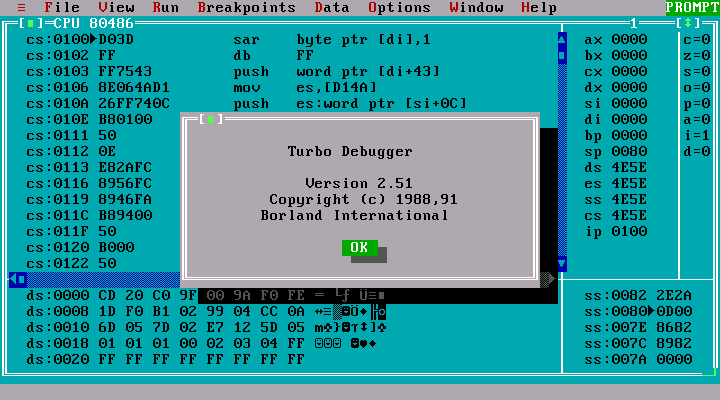
PKZIP was written by Phil Katz, who was a tortured genius in my book. In my opinion his work at the time is under appreciated. His Deflate format was obviously very good for its time to have survived all the way into the internet era.

I single stepped through all the compression and decompression routines Phil wrote in this program. It was a mix of C and assembly. PKZIP came with APPNOTE.TXT, which described the datastream format at a high level. Unfortunately, at the time it lacked some key information about how to decode each block's Huffman codelengths (which were themselves Huffman coded!), so you had to use reverse engineering techniques to figure out the rest. Also most importantly, it only covered the raw compressed datastream format, so the algorithms were up to you to figure out.
The most important thing I learned while studying Phil's code: the entire sliding dictionary was literally moved down in memory every ~4KB of data to compress. (Approximately 4KB - it's been a long time.) I couldn't believe he didn't use a ring buffer approach to eliminate all this data movement. This little realization was key to me: PKZIP spent many CPU cycles just moving memory around!
PKZIP's match finder, dictionary updater (which used a simple rolling hash), and linked list updater functions were all written in assembly and called from higher-level C code. The assembly code was okay, but as a demoscener I knew it could be improved (or at least equaled) with tighter code and some changes to the match finder and dictionary updating algorithms.
Phil's core loops would use 32-bit instructions on 386 CPU's, but strangely he turned off/on interrupts constantly around the code sequences using 32-bit instructions. I'm guessing he was trying to work around interrupt handlers or TSR's that borked the high word in 32-bit registers.
To fully reverse engineer the format, I had to feed in very tiny files into PKZIP's decompressor and single step through the code near the beginning of blocks. If you paid very close attention, you could build a mental model of what the assembly code was doing relative to the datastream format described in APPNOTE.TXT. I remember doing it, and it was slow, difficult work (in an unheated attic on top of things).
I wrote my own 100% compatible codec in all-assembly using what I thought were better algorithms, and it was more or less competitive against PKZIP. Compression ratio wise, it was very close to Phil's code. I started talking about compression and PKZIP on a Fidonet board somewhere, and this led to the code being sublicensed for use in EllTech Development's "Compression Plus" compression/archiving middleware product.
For fun, here's the ancient real-mode assembly code to my final Deflate compatible compressor. Somewhere at the core of my brain there is still a biologically-based x86-compatible assembly code optimizer. Here's the core dictionary updating code, which scanned through new input data and updated its hash-based search accelerator:
As an exercise while learning C I ported the core hash-based LZ algorithms I used from all-assembly. I uploaded two variants to local BBS's as "prog1.c" and "prog2.c". These little educational compression programs were referenced in the paper "A New Approach to Dictionary-Based Lossless Compression" (2004), and the code is still floating around on the web.
I rewrote my PKZIP-compatible codec in C, using similar techniques, and this code was later purchased by Microsoft (when they bought Ensemble Studios). It was used by Age of Empires 1/2, which sold tens of millions of copies (back when games shipped in boxes this was a big deal). I then optimized this code to scream on the Xbox 360 CPU, and this variant shipped on Halo Wars, Halo 3, and Forza 2. So if you've played any of these games, somewhere in there you where running a very distant variant of the above ancient assembly code.
Eventually the Deflate compressed bitstream format created by Phil Katz made its way into an internet standard, RFC 1951.
A few years ago, moonlighting while at Valve, I wrote an entirely new Deflate compatible codec called "miniz" but this time with a zlib compatible API. It lives in a single source code file, and the entire stream-capable decompressor lives in a single C function. I first wrote it in C++, then quickly realized this wasn't so hot of an idea (after feedback from the community) so I ported it to pure C. It's now on Github here. In its lowest compression mode miniz also sports a very fast real-time compressor. miniz's single function decompression function has been successfully compiled and executed on very old processors, like the 65xxx series.
I don't think it's well known that the work of compression experts and experimenters in Japan significantly influenced early compression programmers in the US. There's a very interesting early history of Japanese data compression work on Haruhiko Okumura's site here. Back then Japanese and American compression researchers would communicate and share knowledge:
Also, I believe Phil Katz deserves more respect for creating Inflate and Deflate. The algorithm obviously works, and the compressed data format is an internet standard so it will basically live forever. These days, Deflate seems relatively simple, but at the time it was anything but simple to workers in this field. Amazingly, good old Deflate still has some legs, as Zopfli and 7-zip's optimizing Deflate-compatible compressors demonstrate.
Finally, I personally learned a lot from studying the code written by these inspirational early data compression programmers. I'll never get to meet Phil Katz, but perhaps one day I could meet Dr. Okumura and say thanks.
http://oku.edu.mie-u.ac.jp/~okumura/compression/ar002/
I studied every bit of ar002 intensely, especially the Huffman related code. I was impressed and learned tons of things from ar002. It used a complex (to a teenager) tree-based algorithm to find and insert strings into a sliding dictionary, and I sensed there must be a better way because its compressor felt fairly slow. (How slow? We're talking low single digit kilobytes per second on a 12MHz machine if I remember correctly, or thousands of CPU cycles per input byte!)
So I started focusing on alternative match finding algorithms, with all experiments done in 8086 real mode assembly for performance because compilers at the time weren't very good. On these old CPU's a human assembly programmer could run circles around C compilers, and every cycle counted.
Having very few programming related books (let alone very expensive compression books!), I focused instead on whatever was available for free. This was stuff downloaded from BBS's, like the archiving tool PKZIP.EXE. PKZIP held a special place, because it was your gateway into this semi-secretive underground world of data distributed on BBS's by thousands of people. PKZIP's compressor internally used mysterious, patented algorithms that accomplished something almost magical (to me) with data. The very first program you needed to download to do much of anything was PKZIP.EXE. To me, data compression was a key technology in this world.
Without PKZIP you couldn't do anything with the archives you downloaded, they were just gibberish. After downloading an archive on your system (which took forever using Z-Modem), you would manually unzip it somewhere and play around with whatever awesome goodies were inside the archive.
Exploring the early data communication networks at 1200 or 2400 baud was actually crazy fun, and this tool and a good terminal program was your gateway into this world. There were other archivers like LHA and ARJ, but PKZIP was king because it had the best practical compression ratio for the time, it was very fast compared to anything else, and it was the most popular.
This command line tool advertised awesomeness. The help text screamed "FAST!". So of course I became obsessed with cracking this tool's secrets. I wanted to deeply understand how it worked and make my own version that integrated everything I had learned through my early all-assembly compression experiments and studying ar002 (and little bits of LHA, but ar002's source was much more readable).
I used my favorite debugger of all time, Borland's Turbo Debugger, to single step through PKZIP:
PKZIP was written by Phil Katz, who was a tortured genius in my book. In my opinion his work at the time is under appreciated. His Deflate format was obviously very good for its time to have survived all the way into the internet era.
I single stepped through all the compression and decompression routines Phil wrote in this program. It was a mix of C and assembly. PKZIP came with APPNOTE.TXT, which described the datastream format at a high level. Unfortunately, at the time it lacked some key information about how to decode each block's Huffman codelengths (which were themselves Huffman coded!), so you had to use reverse engineering techniques to figure out the rest. Also most importantly, it only covered the raw compressed datastream format, so the algorithms were up to you to figure out.
The most important thing I learned while studying Phil's code: the entire sliding dictionary was literally moved down in memory every ~4KB of data to compress. (Approximately 4KB - it's been a long time.) I couldn't believe he didn't use a ring buffer approach to eliminate all this data movement. This little realization was key to me: PKZIP spent many CPU cycles just moving memory around!
PKZIP's match finder, dictionary updater (which used a simple rolling hash), and linked list updater functions were all written in assembly and called from higher-level C code. The assembly code was okay, but as a demoscener I knew it could be improved (or at least equaled) with tighter code and some changes to the match finder and dictionary updating algorithms.
Phil's core loops would use 32-bit instructions on 386 CPU's, but strangely he turned off/on interrupts constantly around the code sequences using 32-bit instructions. I'm guessing he was trying to work around interrupt handlers or TSR's that borked the high word in 32-bit registers.
To fully reverse engineer the format, I had to feed in very tiny files into PKZIP's decompressor and single step through the code near the beginning of blocks. If you paid very close attention, you could build a mental model of what the assembly code was doing relative to the datastream format described in APPNOTE.TXT. I remember doing it, and it was slow, difficult work (in an unheated attic on top of things).
I wrote my own 100% compatible codec in all-assembly using what I thought were better algorithms, and it was more or less competitive against PKZIP. Compression ratio wise, it was very close to Phil's code. I started talking about compression and PKZIP on a Fidonet board somewhere, and this led to the code being sublicensed for use in EllTech Development's "Compression Plus" compression/archiving middleware product.
For fun, here's the ancient real-mode assembly code to my final Deflate compatible compressor. Somewhere at the core of my brain there is still a biologically-based x86-compatible assembly code optimizer. Here's the core dictionary updating code, which scanned through new input data and updated its hash-based search accelerator:
;--------------- HASH LOOP
ALIGN 4
HDLoopB:
                ReptCount = 0

                REPT    16

                Mov     dx, [bp+2]

                Shl     bx, cl
                And     bh, ch
                Xor     bl, dl
                Add     bx, bx
                Mov     ax, bp
                XChg    ax, [bx+si]
                Mov     es:[di+ReptCount], ax
                Inc     bp

                Shl     bx, cl
                And     bh, ch
                Xor     bl, dh
                Add     bx, bx
                Mov     ax, bp
                XChg    ax, [bx+si]
                Mov     es:[di+ReptCount+2], ax
                Inc     bp

                ReptCount = ReptCount + 4

                ENDM

                Add     di, ReptCount

                Dec     [HDCounter]
                Jz      HDOdd
                Jmp     HDLoopB
As an exercise while learning C I ported the core hash-based LZ algorithms I used from all-assembly. I uploaded two variants to local BBS's as "prog1.c" and "prog2.c". These little educational compression programs were referenced in the paper "A New Approach to Dictionary-Based Lossless Compression" (2004), and the code is still floating around on the web.
I rewrote my PKZIP-compatible codec in C, using similar techniques, and this code was later purchased by Microsoft (when they bought Ensemble Studios). It was used by Age of Empires 1/2, which sold tens of millions of copies (back when games shipped in boxes this was a big deal). I then optimized this code to scream on the Xbox 360 CPU, and this variant shipped on Halo Wars, Halo 3, and Forza 2. So if you've played any of these games, somewhere in there you where running a very distant variant of the above ancient assembly code.
Eventually the Deflate compressed bitstream format created by Phil Katz made its way into an internet standard, RFC 1951.
A few years ago, moonlighting while at Valve, I wrote an entirely new Deflate compatible codec called "miniz" but this time with a zlib compatible API. It lives in a single source code file, and the entire stream-capable decompressor lives in a single C function. I first wrote it in C++, then quickly realized this wasn't so hot of an idea (after feedback from the community) so I ported it to pure C. It's now on Github here. In its lowest compression mode miniz also sports a very fast real-time compressor. miniz's single function decompression function has been successfully compiled and executed on very old processors, like the 65xxx series.
Conclusion
I don't think it's well known that the work of compression experts and experimenters in Japan significantly influenced early compression programmers in the US. There's a very interesting early history of Japanese data compression work on Haruhiko Okumura's site here. Back then Japanese and American compression researchers would communicate and share knowledge:
"At one time a programmer for PK and I were in close contact. We exchanged a lot of ideas. No wonder PKZIP and LHA are so similar."I'm guessing he's referring to Phil Katz? (Who else could it have been?)
Finally, I personally learned a lot from studying the code written by these inspirational early data compression programmers. I'll never get to meet Phil Katz, but perhaps one day I could meet Dr. Okumura and say thanks.
Subscribe to:
Posts (Atom)